Before Dialogue: How Silent Films Made Action Legible
Learn how silent films make action legible through gesture, framing, and intertitles, so you can follow scenes whose visual storytelling feels unfamiliar.
Why can a silent film’s action be harder to follow than a dialogue-driven movie, even when you can see every movement? Silent films made action legible through gesture, framing, and written intertitles, but those tools ask you to read the screen differently from a movie carried by spoken conversation. When a scene becomes confusing, the answer is usually not to watch harder; it is to notice which visual cue you may have missed.
Locate the action before reading every card
A character enters, points, recoils, or turns toward something beyond the frame. That movement may be the scene’s main sentence, while an intertitle supplies only a name, a thought, or a shift in time. If you read each card as though it were a complete line of dialogue, you can miss the physical event that gives it meaning.
On a first viewing, let a card register, then return your attention to the actors and the space around them. Ask who is present, what has changed, and where each person is looking. Silent-film scenes often establish a situation visually before spelling out crucial information in writing.
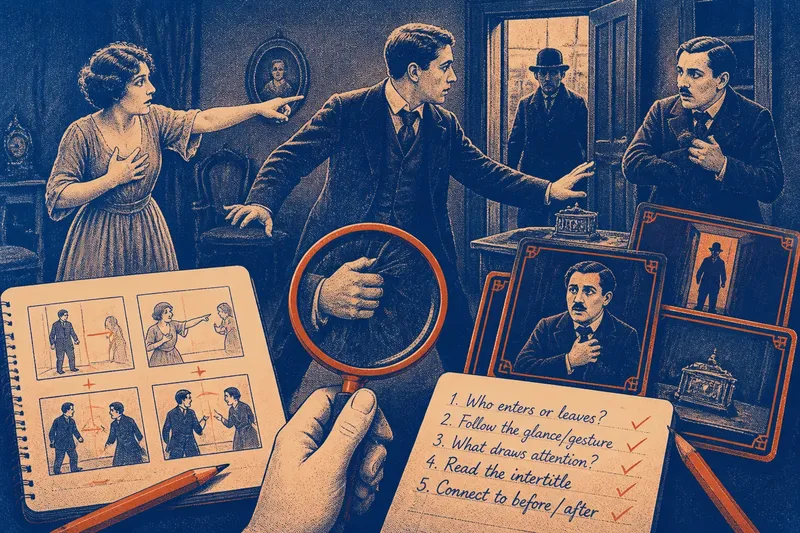
If you lose the thread, try this sequence:
- Notice who enters or leaves the frame.
- Track the direction of a glance, point, or turn.
- Identify the object or person drawing the gesture.
- Read the next intertitle for information the image cannot provide.
- Connect the card to the action immediately before and after it.
This sequence helps separate what the film shows from what it tells you. A card may say that a character is worried, for example, while a clenched hand, stalled step, or guarded look gives that worry a visible shape.
A gesture can seem exaggerated when its purpose is unclear
Silent acting often uses broad, sharply shaped movements because a face or hand had to communicate across a theater and through a fixed camera. A raised palm might signal refusal, a hand pressed to the chest might indicate distress, and a sudden turn might redirect attention. These gestures are not a universal code; their meaning depends on what happened just before and what the character does next.
If an actor’s movement seems theatrical or puzzling, resist translating it into one emotion too soon. First identify the physical action: Is the character hiding something, offering an object, stopping another person, or reacting to an entrance? Then compare that action with the face and posture. A smile paired with a recoiling body, for example, may suggest politeness under pressure rather than uncomplicated happiness.
Imagine a character touches a pocket, looks toward a doorway, and then steps between another person and a table. The pocket gesture could mean almost anything on its own. Read together, the movements may suggest that the character is protecting something or blocking access; a following card or reaction can refine that interpretation.
What is not worth the effort is searching for a fixed dictionary that assigns one meaning to every pose. The useful habit is to read gestures in sequence and in relation to the objects, people, and exits in the frame.
Framing can hide the clue you expect to see
A silent film’s camera placement determines which information is visible at a given moment. In a wide view, you may see several people, a doorway, and an object that will matter later. A closer view can make a face or hand legible while temporarily hiding the room. The film may shift between those views to guide attention, so a confusing moment can come from watching the most expressive face instead of the whole arrangement.
When a character reacts strongly, check the edges of the image and the space behind them. Someone may have entered, a prop may have changed hands, or another character may be watching from a position you overlooked. The frame is not simply a container for acting; it organizes who can see what and who is exposed to whom.
Look, too, at how characters are positioned. A person near a door may have an exit available; someone surrounded by others may have fewer options. Such arrangements do not prove a character’s motive, but they can clarify the immediate problem the scene presents.
If you are watching on a small screen, pause only when necessary and enlarge the image if the player allows it. A hand-held object or a glance toward the background can be easy to miss in a reduced picture. Avoid assuming every tiny detail is a clue: concentrate first on repeated attention, visible reactions, and changes in who controls the space.
Intertitles can interrupt the story without explaining everything
Intertitles are written cards inserted between moving images. Some convey speech; others provide narration, identify a time or place, or express a character’s thoughts. A card that reads like dialogue may still be selective rather than a transcript of every conversation. The film can leave the exchange’s tone, power, or emotional consequence to the actors’ movements.
When a card seems disconnected from the image, classify the information it supplies. Does it name a person, move the story forward, disclose a private thought, or tell you where the scene is happening? Then return to the image and see how the characters respond. A line’s meaning can change when the next shot shows hesitation, disbelief, or an attempt to conceal a reaction.
Some cards use wording or typography to signal emphasis. Treat that as a prompt to pay attention, not as a complete explanation. The action around the card may add irony or show that the speaker’s words are not shared by everyone present.
Presentation can vary by release. If a card is hard to read, use the player’s caption settings or a larger display where available; do not assume that skipping it will leave the scene’s plot intact.
Why does the story seem to jump between moments?
Did I miss a transition card?
A card may indicate that time has passed, the location has changed, or a new event is beginning. Check the next image for a changed setting, costume, group of characters, or stage of an action before treating the shift as a missing scene.
Why does a character react before I know what happened?
The film may show the reaction first and reveal its cause in a later view or intertitle. Follow the character’s gaze and the other people’s responses; the scene may be directing your attention toward something just outside the current frame.
Does a written line tell me exactly what everyone said?
Not necessarily. A speech card can represent a selected line rather than a complete conversation, with gesture and reaction carrying the rest. Read it as one piece of evidence, then check how the exchange changes the characters’ behavior.
What if I still cannot identify an object or gesture?
Hold off on assigning it a precise meaning and watch for a later return to the same object, person, or movement. If the film never gives it more weight, it may have been ordinary business rather than a hidden clue.
Follow reactions to understand who holds the scene
In a dialogue-driven movie, a speaker’s words often seem to own the moment. In silent cinema, the listener’s reaction can carry equal or greater weight. A character may nod while tightening a grip, look away during a promise, or remain still while another person takes over the frame. These responses reveal the relationship beneath the visible action without requiring a spoken explanation.
When an exchange feels emotionally vague, watch the person who is not moving. Does that character accept the gesture, resist it, or wait for the other person to finish? Note who initiates contact and who breaks it off. The scene’s tension can lie in that unevenness rather than in the words printed on a card.
Imagine a character offers a folded note. The recipient takes it but keeps looking toward a third person across the room. The offer itself is clear; the diverted gaze complicates its meaning. A later reaction may show whether the note is a private message, a threat, or simply an object the scene needs to move along.
Let the film’s visual grammar become familiar
Silent-film storytelling does not use one unchanging style. A comic chase may rely on entrances, exits, and objects in motion, while a tense conversation may depend on faces and held poses. Some scenes make the action plain; others withhold information to create surprise. Treat confusion as a question about the scene’s arrangement, not as proof that you have missed an obvious symbol.
When the plot becomes difficult to follow, return to a simple chain: what changed in the frame, who noticed it, and what did that person do next? Then bring in the intertitle as a clue about time, speech, or thought. This approach keeps the image and written card in conversation rather than forcing either to explain everything alone.
That is the practical value of understanding how silent films made action legible: you can follow the visible chain of cause and response before deciding what a scene means. Watch the hands, the eyelines, the doorway, and the person who stays quiet. In a film without recorded dialogue, those details are not decoration around the story; they are often where the story is happening.