A Continuity Slip Is Not Automatically a Clue
A continuity slip can catch your eye without revealing a secret. Compare repeated details and story context to judge whether a mismatch matters.
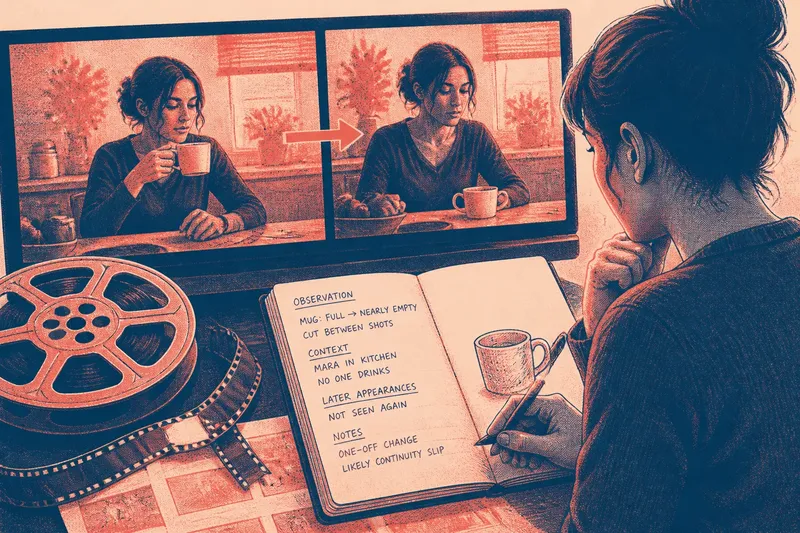
A glass is full in one shot, then nearly empty in the next, though no one has taken a drink. A continuity slip can catch your eye without telling you whether the film made a mistake or planted a clue. Look for a pattern before deciding what the mismatch means.
Record the detail before interpreting it
When you spot a possible continuity slip, hold the observation lightly. A detail can be real and still be accidental; noticing it does not require an explanation.
Write down what changed and where it happened. “Mara’s mug is full after she takes a drink” records an image. “The mug means she is hiding something” adds a theory before the film has provided support.
Movies are assembled from separate pieces of performance and production. A gesture, prop, costume, or background detail may shift between shots for ordinary practical reasons, and the finished scene can retain that mismatch without making it meaningful.
Compare the detail across the film
A deliberate visual motif usually gains meaning from how it returns, not merely from the fact that something looks similar twice. Its context, timing, or relationship to a character may change in a way that gives the repetition a purpose.
Imagine you notice a red scarf on a chair in two scenes. In the first, it belongs to a character who has just arrived; later, the same color and placement appear after that character leaves, while another person avoids the chair. That recurrence could invite a reading about absence or memory. If the scarf only shifts position between adjacent shots and never matters again, a continuity slip is the simpler explanation.
Resemblance alone is not repetition with meaning. Two similar cups, doorways, or gestures may belong to separate moments without forming a motif. Ask whether the film draws attention to the likeness and whether the detail develops alongside the story.
Use a focused viewing routine
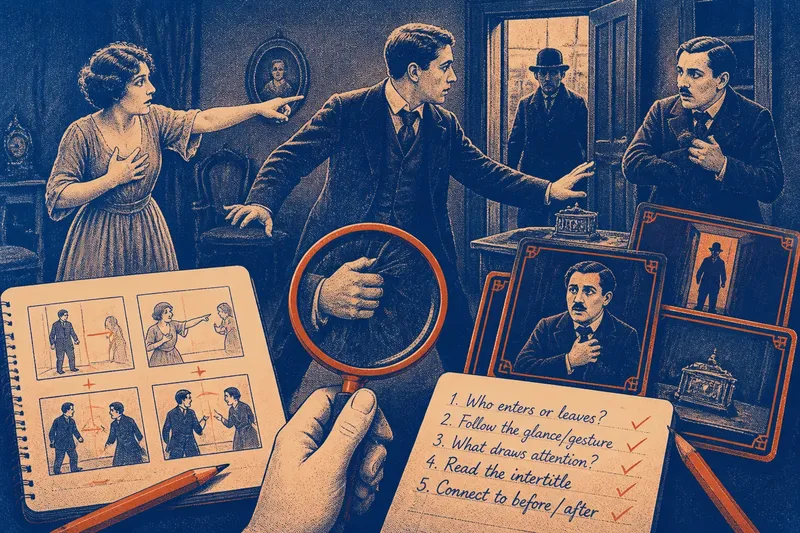
You do not need to inspect every frame. A short set of observations can help distinguish a recurring pattern from a one-off mismatch while keeping the story in view.
- On the first viewing: If a mismatch catches your attention, note the object or action and keep watching; if it does not seem relevant, do not stop the scene to analyze it.
- After the scene: Write one plain sentence describing the change and what was happening around it; if you can state only a theory, return to the image and separate what you saw from what you inferred.
- When recalling later scenes: If you remember the same feature elsewhere, note where and how it appeared; if you are unsure, mark that uncertainty rather than treating memory as confirmation.
- On a later viewing: Rewatch the relevant passage and neighboring shots; if the detail changes only once between adjacent shots, consider a continuity slip, but if it recurs in distinct story moments, compare its contexts.
- When comparing contexts: If the film connects the detail to a character’s actions, mood, or point of view, consider a motif; if no other scene or story choice supports that reading, keep the interpretation modest.
- After comparing: If the film offers no further connection, leave the detail as an unexplained mismatch; if new scenes strengthen a pattern, describe the pattern without claiming certainty about its meaning.
Say you notice, in an invented example, that a character’s blue umbrella is open in one shot and closed in the next, though the character has not moved. You note the change, then revisit the scene and see that it happens only across those adjacent shots; later, the umbrella appears closed again when the character enters a dry hallway, with no special emphasis. The result is a reasonable decision to call the first change a likely continuity slip, not a developed motif. It is not worth pausing over every background object or replaying a scene until a theory feels persuasive; that effort can make incidental details seem important just because they received so much attention.
Separate a production mismatch from story information
A prop may change position, a costume detail may shift, a person may stand differently, or a background element may appear inconsistent. Identifying the change accurately is useful, but its presence alone does not tell you why it happened.
Story information works differently. A film may show a character remembering an event imperfectly, imagining an alternative, or experiencing an unstable point of view. When that matters, other choices may support the reading: a repeated scene with altered details, a shift in what the audience can know, or a clear connection between the image and the character’s state of mind.
Do not treat one mismatch as proof of an unreliable narrator, a dream, or a secret timeline. Those interpretations make more sense when several choices support them, rather than when one cup or sleeve has to explain the whole film.
How should you judge an odd detail?
How can I distinguish a continuity slip from a motif?
Check whether the detail returns in a new context and connects to character behavior, story events, or the film’s visual emphasis. A one-off mismatch with no developing connection is more plausibly an inconsistency than a motif.
Does a repeated object always carry symbolic meaning?
No. Repetition can make an object recognizable or help a scene feel cohesive without giving it a larger symbolic purpose. Look for a developing relationship between the object and the story before assigning meaning.
What if the film never explains the mismatch?
Leave it unresolved. Some details remain ambiguous, and some are simply errors; you do not have to choose between an elaborate theory and certainty about how the mismatch happened.
Should I pause when I spot something odd?
Usually, keep watching and note the moment for later. Pausing can interrupt the scene and encourage a premature explanation, while a later comparison lets you judge the detail in context.
Keep the interpretation proportional to the evidence
A useful reading should account for more than the one inconsistency that inspired it. If a theory explains a recurring visual pattern but clashes with the characters’ actions or other scenes, revise it or set it aside. The detail may still be interesting without being a clue.
When you revisit a continuity slip, describe what changed, check whether the film repeats or develops that change, and decide how much weight it can reasonably carry. This approach keeps close looking enjoyable while leaving room for an ordinary production mistake. The glass moved; the story may have moved on.